Yes, they certainly do. Christmas here is a festival which 'belongs' to the Christians, who are numerous, although a minority. It's a 'jour ferié', that is a national holiday. And non-Christians celebrate it too, mostly as an occasion for children, and an excuse for lovely new clothes. Non-Christians call on their Christian neighbours to wish them 'bonne fête' and hope to be offered food and drink.
In the one real supermarket in Bobo, frequented by 'toubabous' (whites) and affluent locals, there have been toys and even some christmas trees. Decorations are on sale at street stalls - including shiny garlands which we might string across the ceiling but which here can be used to wrap round and round a woman's head, over an artificial hairpiece, to prepare to go out dancing!
Does the place come to a standstill? No. Some examples of that - Christmas as you may have noticed falls on a Saturday this year. Saturday is a working day for many, so no need for an extra day off. On Christmas Eve those who work in the public service or organised structures like ours worked a 'journée continue', which means straight through without a lunch break to 2pm, and then finish - no afternoon session. I left at about 2.15 but I suspect several colleagues were there much later. Not being sure what would be open the next day I popped out to buy some fresh veg - this turned out to be an unnecessary precaution as the local market was much as ever on Christmas Day - just a few of the usual stalls were not there.
December is the end of the financial and administrative year here (many people find our April-March year, used here by some international funding bodies) hard to understand. So lots of people are busy with reports and with finishing projects. Or even starting them - on about 20th December our organisation was asked to start a new project - a small one - to be finished by year end. No problem, the required 4 activities were all programmed in and will mostly be done next week. On 23rd December we had a monitoring visit from a funder reviewing the work of another project - the meeting went on until about 6.30 or 7 pm, and the report which is needed to complete the project will be produced and submitted by the middle of next week - I think the deadline is 28th. So people may well be working on it this weekend - no report, no funding transfer, nobody gets paid at the end of the month - and will certainly be hard at work next week.
And lots of people, Christians included, work on Christmas Day, and not just in essential services. Many are not able to spend the day with family, or even eat together - they may be working, or too far away, or not have the money for festive food. One Christian Burkinabe friend who brought her two kids to visit on Christmas Day said it was the first time for 5 years that they had been able to celebrate Christmas by spending the day together.
And the Toubabous? On Christmas Eve we partied with the other volunteers here in Bobo and some local friends (thank you very much, Eve, Simon and family). We? Les has come out to visit me (my best Christmas present) and to see Burkina. He has been welcomed by the neighbourhood, particularly the children who clamour at the door for Papa Noel. Yesterday we wandered around the local market and neighbourhood, greeted friends, ate off and on all day but on a much more modest scale than we usually would at Christmas, and enjoyed the sunshine which was pleasant if a bit hot around midday. We handed out photos I had taken last festival, which Les had printed and brought from UK (the wonders of digital photography and internet communication). These were received with great pleasure and excitement, huge smiles and lots of giggles - and took some more pics of people in their new best clothes. A great way to spend Christmas Day.
In a day or two we are off to Ghana for a little holiday - it will be interesting to experience an anglophone country in contrast. So 'Boxing Day' will see us packing our bags, and perhaps going for a swim.
So I shan't be writing about New Year in Bobo - I may in due course write about New Year in Ghana, but won't be writing much at all for a couple of weeks. Festive greetings and Happy New Year to all my readers, and sympathy (well a bit) for those who are suffering as a result of the weather. Thank you to everyone who has sentfestive emails, I really do like hearing from you and will try to be better about responding individually.
See you next year!
Saturday, 25 December 2010

Friday, 10 December 2010
Big Birthday in Bobo
Burkina Faso is celebrating 50 years of independence this year. Independence day was in August, but the big celebration is tomorrow - and it is happening in Bobo!
Ever since I arrived in April, I have seen signs of activity leading up to this - most noticeably, they have been rebuilding the main roads in Bobo, which has led to loads of roadworks, diversions, bumpy surfaces and or course red dust. But in the last few days the roads have miraculously received tarmac surfaces, which is a big improvement.
It's a bonanza for anyone who sells or applies paint - painters have been madly at work smartening up buildings, walls by the side of the road, the mosque, the railway station... Lots of things have turned white; no doubt over the months which follow they will turn rusty beige again. A bonanza for banner makers too - banners are sprouting everywhere, linking promotion of anything from mobile phone networks to stock cubes to the anniversary. In Ouaga the cost of minibus hire has spiralled; here accommodation is all booked up, and shiny new signs pointing the way to hotels and restaurants seem to have sprouted over night. Bobo is suddenly crawling with gendarmes and uniforms of every kind - I have seen mounted police for the first time here.
Manufacturers and vendors of flags, bunting and anything red green and yellow; purveyors of promotional t-shirts and polo shirts (known locally as 'Lacoste') - all seem to be doing well.
Plants have appeared in the middle of dual carriageways, decorative lights have been attached to lamp-posts. In the last few weeks and days, building projects which have lasted months seem to have finished, with workers staying late at night. Temporary stages and eating places are mushrooming. Indeed almost everything looks almost ready. I have never seen Bobo looking so well turned out. Tomorrow will tell.
Pictures will follow!
Thursday, 2 December 2010
December 1st...


Yesterday, 1st December, was Journée Mondiale de Lutte contre le Sida - World Aids Day, for Anglophones.
So there was a big parade in Bobo for all Associations involved in VIH-SIDA, ours included. Everyone gathered outside the iconic railway station, hung around for a bit chatting, donned our various and much coveted t-shirts, unfurled our banners and set off down the newly tarmaced avenue toward the Gouvernorat. Led by a lorry with the obligatory sound system, belting out various VIH-SIDA songs, of which there are plenty, and with disc jockey types yelling out publicity and health messages.
Impressive (if also depressing) to see how many people in Bobo are active in this domain, many on a voluntary basis. A huge pool of effort and goodwill.
On reaching the Gouvernorat, there were speeches, a comic sketch on a VIH theme, and lots more music, disc jockey comment and clapping. Then the lorry, laden with t-shirted and noisy passengers, set off on a tour on the main roads round town spreading the messages and promoting the afternoon’s activities, ending up at the centre which co-ordinates VIH-SIDA activity.
There a repas communautaire ensued – vast vats of riz gras (rice with some veg and meat) were served up. People eat in groups of 5-10, and each group gets given a plastic (washing up) bowl full of food to share, eating with fingers, having washed their hands first. The ladies with green headdresses are from the Nigerian community.


Elsewhere, there was free testing (with counselling), theatre with HIV-AIDS messages, distribution of leaflets and condoms and of course more music. The whole event featured strong attendance from 'the authorities' and a lot of media attention - fortunately it also coincided with a training course for local journalists being mounted by a French organisation. Cameras everywhere.
An impressive show of commitment and commitment is still very much needed – HIV-AIDS may be much better understood than it was, but there are still huge problems of ignorance, stigmatisation, non-availability of drugs and lack of money to pay for treatment.
There is a huge discrepancy in the facilities and treatment on offer around the world – a couple of telling facts (thanks to Eve):
• Mother-child transmission has been virtually eliminated in Canada, but is still common here.
• Average life expectancy for those diagnosed HIV+ in Canada (adults and children) is 31 years.
• 64% of HIV+ babies here will not make it to their first birthday. The other 36% have an average life expectancy of 16.
Is one day enough?
Thursday, 25 November 2010
What men wear


The men here dress in a huge variety of clothes - ranging from something like a western suit (those will be the ones who work in air conditioned offices)to outfits which, to the untutored eye, resemble pink frilly pyjamas.
The smartest people I have come across yet are those who work in the banks. I haven't been into a bank for a long time, because the most practical way to get money is from a cash dispenser (when it's working). Withdrawing money over the counter usually involves at least one long queue. A well ordered queue, mind you. It's not always easy to tell which booth has the shortest queue, because people don't necessarily stand in line; the system, as I eventually found out, is that you enquire as to who is last in the queue when you arrive, and then you just follow that person. Same thing for paying the electric or water bill. Occasionally people attempt to queue-jump and this is not well regarded. Queuing in banks is not unpleasant, as they are usually pleasantly cool (air-conditioned, except in a power cut) and with some seating. Not so everywhere.
Anyway, in the early days when I was waiting the several weeks for my bank card to be ready, and so frequenting the inside of banks, I was struck by how smartly dressed, in a western style, the bank employees were. Suits, shirts etc.
Public figures, such as the Ministers who have been conspicuous as patrons of various benevolent activities in the run up to the election, vary their dress between western suits and traditional outfits - they may turn up in a long tunic, worn over matching trousers, made of the local bazin. Village chiefs also vary in their approach, but tend, in my limited experience, to include at least one traditional element. For everyday work and play, young men will tend towards jeans, with perhaps a polo shirt or a short-sleeved cotton shirt of either western or traditional fabric - but may turn up from time to time in printed or embroidered brightly coloured matching shirt and trousers. For footwear - it could be flip-flops, trainers, or leather shoes - usually leather or pseudo-leather shoes if it's a western suit.
Sports kit - shorts, shirts, tracksuits, baseball caps - especially those for the popular footballers Drogba and Eto'o - are much favoured by the young too, and regarded as smart. T-shirts and polo shirts abound, and there are many examples of what must be discarded corporate wear from other countries. And, of course, as it has been election time, the t-shirts and baseball caps carrying pictures and slogans supporting Blaise Compaore which are a regular part of electioneering.
Older men tend to the traditional boubou - long tunic over trousers, often but not always a plain colour. Sometimes - generally I think among Muslims - this is accompanied with a cap. Professional men, such as doctors, psychologists, accountants, generally wear western style trousers with a short - or as it gets slightly less hot - long-sleeved shirt - but again may turn up from time to time in traditional dress of one sort or another.
And there are a few who wear ties, which seems a strange form of penance in this heat. Apart from the bank employees, I have seen ties on a waiter in an aspirational restaurant - tied so short it reminded me of rebellious schoolboys - and on a few officials. Ties are seen as exotic - for one of the recent festivals, one of the young men of the neighbourhood had got his hands on a tie; not knowing how to tie it (not part of the ritual of growing up here to learn that)he turned up on my doorstep for advice. I was of course happy to oblige - long time since I tied a tie for anyone! Anyway, he was pleased with the result, and considered it very 'cool' - probably the second or third most common English expression here (after bye-bye and weekend).
For special occasions, such as baptisms and marriages, or religious festivals, most men will wear traditional bazin outfits, and very fine they look too. Occasionally, as for the cinquantennaire of the school in Bobo, they will wear clothes made from specially printed pagne fabric. For burials, which are often held the day of death, it's come as you are if you get the text message in time.
And then, wandering around Bobo, there are several men (whose mental state is in some doubt)who wear either just a few rags, or absolutely nothing at all... They are well known local characters, showing little regard for either traffic or people. Perhaps they are the coolest of all?
For more pictures of what men, and boys (and some women) wear, follow this link:
http://picasaweb.google.com/111172062905554064052/WhatMenWear?authkey=Gv1sRgCLvLy7fLlYLWPw#
Monday, 15 November 2010
When a door opened
In September 1960, at the beginning of the school year, a 19 year old newly qualified teacher arrived in the village of Biba, towards the north of Burkina Faso (then Upper Volta).

His task - to open the first school there, for which he had a 3 room building - also to be his home - and a lorry-full of combined desks and chairs. Before then, the only way to get an education was to travel every week, on foot or by bicycle, to the small town of Toma, some 9 kilometres away, and stay with friends or relatives. Unsurprisingly, few children went; most stayed at home and played their part in the local economy, minding sheep and goats and helping out in the fields at busy times such as planting and harvest. So the teacher's first task was to persuade local families to send their children to the school. Quite a challenge, given that he was a Mooré- speaking Mossi - so different ethnicity, different language from the local Samo (ethnicity and language). It took some time, but he enlisted the help of local community leaders, and was ultimately successful. He integrated well into the local society, marrying a local girl. This first teacher only stayed a year, but the fruits of his labour, and of those who followed him, are abundantly clear. He laid firm foundations - 50 years on, the alumni include plenty of people educated to university level, with enough skill, energy and commitment to organise a 'cinquantennaire' for the school. Just a few of the huge number of local people for whom doors have been opened by education. I was privileged to attend this event. Why? Because among the leading lights of the organising committee were the Secrétaire Permanente of the Association where I work and her brother. When the members of the organising committee were at school, 2 classes were taught in each of the 3 classrooms, making up the 6 classes of the primary education system. Today, there is a second, larger, primary school, and a secondary school, and the promise (this is election year) of a fully-fledged lycée which would enable students to study locally up to Baccalaureate level.

The whole event was quite an organisational feat. We travelled from Bobo in a specially chartered bus, which had started its life as a USA school bus (a Blue Bird, made in Georgia, for those of you who are bus-specialists). Laden with Bobo-dwelling Biba-ites, and sacks of rice and other presents, we travelled a couple of hours up a good tarmac road to Dédougou, stopping only, on the outskirts of Bobo, for fuel, bananas and other roadside snacks, then another couple of hours on a 'red' (ie unsurfaced) road of varying quality to Toma, where we made a brief stop for the driver to do a spot of shopping before winding the last few kilometres to Biba. There was a great atmosphere on the bus - mainly adults with just a couple of kids, as most had left their kids in school in Bobo. Lots of joking and joshing, and adjusting of the overladen luggage racks.
In Biba we stayed in the family village house, fascinating in its own right. People here don't really live in their houses - though they often sleep in them. They live in the courtyard outside, which is where they cook, eat, and chat.
So a small house can be home to quite a large number. Hard, with the great influx, to be sure quite how many in this case, but it makes for flexibility. The village was wonderfully peaceful after the hubbub of Bobo - a few animal noises and only the odd bit of amplified music, quiet lanes between vegetable gardens, lined with distinctive granaries. We washed in an open-roofed but entirely discreet enclosure, supplied with a large bucket of hot water, and a great view of granaries, sky and at night stars (under which we slept for a while).
For the ceremony, special cloth had been ordered, and special t-shirts. The cloth was made up by individual tailors in any number of designs and patterns, which gave great interest and variety. The 'hostesses', who escorted the dignitaries around, wore a fetching mix of traditional Samo pagnes and sashes with specially printed t-shirts.

The ceremony consisted of a series of speeches by visiting dignitaries, and some singing and dancing and performance by schoolchildren and musicians - with the costumes a real feast for the eyes. And lots of applause of course!
 And surrounding it all, lots and lots of formal and informal eating (rice, a kind of bean/lentil from the Baobab tree, pieces of sheep, to (a paste made from maize or millet) and various sauces, pieces of chicken and guinea fowl...
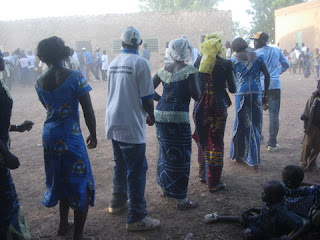 That afternoon, there was community dancing - colourful, but very dusty,so we did not stay long. Between the various formal events there was time to explore the village, and see people making dolo (millet beer), working metal, and carrying on village life. The next day, there was a 'community meal' at which all the Biba returnees ate together, before embarking on their various journeys home to their various locations.

After 2 nights in Biba we headed back to Bobo in the bus, this time laden with sacks of beans, chickens, and a goat on the roof. And arrived safely back, tired but with loads of pictures and memories... Arriving back in the flat, the noise of the street and the town was striking - I can see why the Bobolais enjoy their trips back to the village. And my word, how enormously education can change individual lives.
To see more pics of this outing, follow these links:
http://picasaweb.google.com/111172062905554064052/BibaTheJourney?authkey=Gv1sRgCJLywqqqgMLV2QE#
http://picasaweb.google.com/111172062905554064052/BibaTheVillage?authkey=Gv1sRgCNKCpPqz5OTtJA#
http://picasaweb.google.com/111172062905554064052/BibaTheCeremony?authkey=Gv1sRgCJnNga3CpLCH0QE#

His task - to open the first school there, for which he had a 3 room building - also to be his home - and a lorry-full of combined desks and chairs. Before then, the only way to get an education was to travel every week, on foot or by bicycle, to the small town of Toma, some 9 kilometres away, and stay with friends or relatives. Unsurprisingly, few children went; most stayed at home and played their part in the local economy, minding sheep and goats and helping out in the fields at busy times such as planting and harvest. So the teacher's first task was to persuade local families to send their children to the school. Quite a challenge, given that he was a Mooré- speaking Mossi - so different ethnicity, different language from the local Samo (ethnicity and language). It took some time, but he enlisted the help of local community leaders, and was ultimately successful.
 He integrated well into the local society, marrying a local girl. This first teacher only stayed a year, but the fruits of his labour, and of those who followed him, are abundantly clear. He laid firm foundations - 50 years on, the alumni include plenty of people educated to university level, with enough skill, energy and commitment to organise a 'cinquantennaire' for the school. Just a few of the huge number of local people for whom doors have been opened by education. I was privileged to attend this event. Why? Because among the leading lights of the organising committee were the Secrétaire Permanente of the Association where I work and her brother. When the members of the organising committee were at school, 2 classes were taught in each of the 3 classrooms, making up the 6 classes of the primary education system. Today, there is a second, larger, primary school, and a secondary school, and the promise (this is election year) of a fully-fledged lycée which would enable students to study locally up to Baccalaureate level.

The whole event was quite an organisational feat. We travelled from Bobo in a specially chartered bus, which had started its life as a USA school bus (a Blue Bird, made in Georgia, for those of you who are bus-specialists). Laden with Bobo-dwelling Biba-ites, and sacks of rice and other presents, we travelled a couple of hours up a good tarmac road to Dédougou, stopping only, on the outskirts of Bobo, for fuel, bananas and other roadside snacks, then another couple of hours on a 'red' (ie unsurfaced) road of varying quality to Toma, where we made a brief stop for the driver to do a spot of shopping before winding the last few kilometres to Biba. There was a great atmosphere on the bus - mainly adults with just a couple of kids, as most had left their kids in school in Bobo. Lots of joking and joshing, and adjusting of the overladen luggage racks.

In Biba we stayed in the family village house, fascinating in its own right. People here don't really live in their houses - though they often sleep in them. They live in the courtyard outside, which is where they cook, eat, and chat.

So a small house can be home to quite a large number. Hard, with the great influx, to be sure quite how many in this case, but it makes for flexibility. The village was wonderfully peaceful after the hubbub of Bobo - a few animal noises and only the odd bit of amplified music, quiet lanes between vegetable gardens, lined with distinctive granaries. We washed in an open-roofed but entirely discreet enclosure, supplied with a large bucket of hot water, and a great view of granaries, sky and at night stars (under which we slept for a while).
For the ceremony, special cloth had been ordered, and special t-shirts. The cloth was made up by individual tailors in any number of designs and patterns, which gave great interest and variety. The 'hostesses', who escorted the dignitaries around, wore a fetching mix of traditional Samo pagnes and sashes with specially printed t-shirts.


The ceremony consisted of a series of speeches by visiting dignitaries, and some singing and dancing and performance by schoolchildren and musicians - with the costumes a real feast for the eyes. And lots of applause of course!
 And surrounding it all, lots and lots of formal and informal eating (rice, a kind of bean/lentil from the Baobab tree, pieces of sheep, to (a paste made from maize or millet) and various sauces, pieces of chicken and guinea fowl...
 That afternoon, there was community dancing - colourful, but very dusty,so we did not stay long. Between the various formal events there was time to explore the village, and see people making dolo (millet beer), working metal, and carrying on village life. The next day, there was a 'community meal' at which all the Biba returnees ate together, before embarking on their various journeys home to their various locations.

After 2 nights in Biba we headed back to Bobo in the bus, this time laden with sacks of beans, chickens, and a goat on the roof. And arrived safely back, tired but with loads of pictures and memories... Arriving back in the flat, the noise of the street and the town was striking - I can see why the Bobolais enjoy their trips back to the village. And my word, how enormously education can change individual lives.
To see more pics of this outing, follow these links:
http://picasaweb.google.com/111172062905554064052/BibaTheJourney?authkey=Gv1sRgCJLywqqqgMLV2QE#
http://picasaweb.google.com/111172062905554064052/BibaTheVillage?authkey=Gv1sRgCNKCpPqz5OTtJA#
http://picasaweb.google.com/111172062905554064052/BibaTheCeremony?authkey=Gv1sRgCJnNga3CpLCH0QE#
Saturday, 13 November 2010
The fate of the sheep

Bobo is filling up with sheep. By the roadside, on patches of open ground, small and larger flocks of sheep are appearing, each one with a minder or two. Because next week is Tabaski, the ‘fête du mouton’, the biggest festival in the Muslim calendar, when the non-sacrifice of Isaac by Abraham is celebrated. And for the fête, everyone has to have their mouton, so of course prices are on the up – dramatically so.

Flocks of sheep cross the roads, even the busy dual carriageway, and traffic slows down. Beside the road, individual negotiations take place, and sometimes a sheep or two is carried off on a moto, all in high spirits.

Tabaski is a national holiday – ‘jour ferié’. So, the day before, people work a ‘journée continue’ with no lunch break, and finish at 2pm. Tabaski is printed in red on various calendars, some showing it as the 16th and some as the 17th. Uncertainty reigned until there was an announcement on the radio last Thursday (less than a week to go) confirming the fête for Tuesday 16th.
All this causes some problems for those trying to programme events and activities – which is our major preoccupation at work at the moment, as due to various delays, we have to get some 50+ events in before the end of December. One of our major funders insisted that we plan their launch event in the week15-20 November – and that no events take place before the launch. We had envisaged an earlier launch date – originally early November, and then we had planned for the 12th – and so several events, carefully organised to coincide with various market days, have had to be re-planned. And not a good week to choose really, as the 16th and 17th, possible holidays, were ruled out, and the days before or after a major holiday are not good either – so to cut a very long story short we will now be launching on the Saturday. I have lost count of how many different versions of the programme there have been!
Even government is not immune – there are elections imminent, and a local Minister had called a big rally for the 16th (presumably he thought the fête would be the 17th) which has also had to be rearranged – stadium booking, buses to carry supporters, and presumably some food to entice them along…
As well as being good news for sheep traders, the holiday is big business for fabric sellers and tailors, because many people, especially children, have new outfits – often in the beautiful local bazzin fabric – which has a self-pattern and is dyed in a range of wonderful colours, and starched and beaten to achieve a polished effect. So it should be a feast for the eyes as well as the stomach. Watch this space, there may be pics!
Sunday, 24 October 2010
Hold the line please …

Ok, time for something different – I’ve been meaning for ages to write about the phone system here – which of course is beginning to seem normal to me. Like many things here, it works – after a fashion. And there are workarounds to its limitations.
There are fixed telephone lines, provided by the national Onatel – most companies/organisations and some more affluent private individuals have them. But much more business is transacted from mobiles ‘portables’. Almost everyone I come across in town has one or more of if these, and people’s personal mobiles are routinely used for business purposes – if you want to reach someone, you go for their mobile. In the villages, phone ownership, and network availability, is more spasmodic.
Everyone at work has at least one mobile and there are 2 landlines – one is a ‘ligne verte’, that is a free line (from fixed phones and one network), which was set up as an HIV-AIDS help line, but is now more often used by family and friends as a way of contacting people who work or hang out there; the other is a standard line.
When I first arrived I was puzzled, then, as to why so much time was spent going to the neighbouring telecentre to make calls. There is a telecentre pretty much on every street corner. These are cabins where you can call from a landline, on a meter, and pay afterwards.

There are 3 companies providing mobile services. Calling to the same network is relatively straightforward and cheap, texting more so – although quite often even then calls and texts won’t go through, and the network is quite often too busy. Calling from one network to another is something else. So many people, certainly many people in business like, for example, electricians, will have a SIM card (‘puce’) for each network, and often therefore two or three phones. The networks can be identified by the first two digits of the phone number, so for preference you ring or text your contact from the same network. Or perhaps it may have to be from the network where you currently have some credit… So the directory on my phone has multiple numbers for lots of people, so I can recognise incoming calls, and if possible if I need to contact them, I can do so through my network. As not everyone has as many phones as they have numbers, there is a lot of inserting and removing of SIM cards, and calls and messages are of course missed as a result.
The telecentre is the cheapest way to make calls other than to the same network, and routinely used at work to phone a mobile. So someone may go to the telecentre, call a contact, and ask them to ring back on the ligne verte – and then scurry back to the office.

The fixed lines do work, but are temperamental. Whereas in the UK I was supposed to answer the phone at work within 3 rings, and this was monitored, here it is better to let it ring 3 times before answering, as this improves the success rate.
There are a number of other consequences of this elaborate system – often when someone rings up to speak to one of my colleagues, that person is out at the telecentre making another call; with so many phones in circulation, they are frequently out of battery power, or credit, or both; and a high percentage of all calls seem to consist of someone seeking the number, or the other numbers, of another person..
Ingenuity prevails as ever – there is much use of ‘beeping’ – ie making a call which is terminated before it connects – to deliver simple messages (eg I am ready, call me on the ligne verte…). And there is a cunning system, 'sap sap', which enables you to buy credit for someone else who is somewhere else - you buy the credit and text it to them! Do we have that at home? If so I haven't come across it.
And of course portable phones fulfil many other functions too – they are what people routinely use for calculator, camera, watch, portable music system, and torch. Saves on pocket space. So no wonder there are so many booths selling phones and accessories and carrying out repairs to them – more I think even than bicycle workshops.
Subscribe to:
Posts (Atom)
